Monday, June 1, 2015

194. The Big Bad Wolf


SERIES: Silly Symphony
RELEASED: 1934

The Three Little Pigs return to find they share a common enemy with Little Red Riding Hood: the Big Bad Wolf.

The Three Little Pigs was a surprise success for Walt Disney. More than any Silly Symphony that came before, it was extraordinarily popular with a theme song that spread like wildfire. And much like today, the public began clamoring for a follow-up. Theater owners who saw the draw of the first short began to demand "more pigs". Walt had no interest in sequels. He didn't want to repeat his past successes, he wanted to move forward and try new things. He didn't see the Three Little Pigs as repeat characters like Mickey Mouse; it was a telling of the fairy tale, the story was told, the end. However, Walt did bow to the whim of the people, and the company ultimately made three more shorts featuring the Three Little Pigs (the Pigs also made cameo appearances in a few others). The final one, "The Practical Pig", was released as the first and only short in the Three Little Pigs own series (today it's generally lumped in with the Silly Symphonies like the others). The first of the Pig sequels, "The Big Bad Wolf", ultimately proves that Walt was correct and that sequels are rarely as good as the original.

Perhaps Walt's reluctance to go forward with a sequel explains the story for this short, which is not really about the Pigs at all. Instead, it's mostly an attempt to tell "Little Red Riding Hood" in the Silly Symphony tradition. Since a Big Bad Wolf features in both stories, it is clever to use the character already introduced. The short ends up being a slightly uncomfortable marriage of stories between Red Riding Hood and the Pig that never quite pays off. Audiences who came wanting more pigs were probably a bit disappointed. One wonders whether a straight, swine-less Red Riding Hood short might have worked better. Yet, I appreciate Disney's attempt to please audiences while doing something different, and while it's not the best of the Pigs shorts, it has fun moments. It works better if taken more as a Red Riding Hood short than as a true sequel. The "Practical Pig" is once again the moral compass, making explicit the lesson to avoid shortcuts. But somehow I think involving the Pigs takes away from Little Red. Interestingly, by bringing a new character into the world of the Pigs, Disney ends up slowly building a kind of fairy tale world where all these characters live. The later Silly Symphonies would exploit this a little further, as characters would sometimes turn up in other shorts. Eventually, the Mickey Mouse and Silly Symphony series cross-pollinated characters (Donald Duck began in a Silly Symphony before jumping over to Mickey cartoons, and Pluto starred in a Silly Symphony before getting his own series). Those who think Marvel's "cinematic universe" is unprecedented should pay more attention to what studios were doing in the 1930s.

I love the design on Little Red Riding Hood. She resembles a living Kewpie doll, which I'm sure was part of the intent. Take a look at her hands and how teeny tiny her fingers are! They've really played up her sort of infantile innocence with design choices like that. I also like the way she skips.

The Big Bad Wolf had several disguises in his first appearance, and this trend carries into the other shorts as well. This one introduces a new element: a tendency to now dress in feminine costumes. It's worth remembering this is years before Bugs Bunny. Having him try to seduce Red Riding Hood in the woods not as himself but in drag as "Goldilocks the Fairy Queen" is a fun it of added silliness. And even though it doesn't really go anywhere (as his disguise fails fairly quickly), the business of him flitting about from the trees and singing is delightfully goofy. I consider this short far inferior to the original, but this sequence always makes me laugh. Perhaps this disguise also helps sell the idea of him disguised as Grandma later: he has a penchant for drag disguises!

The middle of the short, which plays the Red Riding Hood exchange without porcine interference, is the highlight. The Big Bad Wolf is a fun character in the way he riffs on a well-known story. He even breaks the fourth wall at one point. I always laugh when she asks how he feels and he says, "Terrible!" in his wolf voice. Many Disney cartoons of this period feature a Jimmy Durante joke. He was a popular star of the time, known for his big nose. You may recognize him as the narrator of Frosty the Snowman. This short has perhaps the best Durante joke in the entire Disney canon, as the Wolf slips in an impression after the "what a big nose you've got!"


zEvn8rhC1PHaKSNpondLC2exDQB.jpg   


This cartoon follows a more sanitized version of the story. The Red Riding Hood tale is one that gets less and less grim with each generation. The earliest versions feature not only Grandma but also Little Red getting eaten by the wolf. No salvation or happy ending, just a cautionary tale about traveling through the woods. Later versions introduce a hunter who kills the wolf and frees Grandma from inside him. The Grimm version takes this one step further by not killing the wolf, but filling its belly with rocks after rescuing Grandma. More recent versions have done away with the eating altogether, and the Wolf just hides Granny in a closet or cupboard due to his haste. This is the version used by Disney. On one hand, it's sad that the story has gotten so far away from its roots, where the central incidents remain but the themes about safety do not. Still, Disney is making a cartoon for laughs not for education, and still managed to throw the lesson in there. It was smart to use the Practical Pig in the huntsman role, as he already has a history of defeating the Wolf. Just as in the first cartoon, a fireplace plays a crucial role. This time, the Pig fills the Wolf's pants with popcorn and hot coals. The popping of the corn perhaps recalls subliminally the shot of a hunter's gun. Also, I can't help wondering if the hot coals are a nod to the rocks in the belly from the Grimm version. Disney often has fun with popcorn in its cartoons. I think this may be the first time.

The final moment of the cartoon, in which the Pigs sing, "Who's afraid of the Big Bad Wolf? He's a great big sissy!" feels unearned to me in a way, and more a way to reference the prior short. He was a very real threat, and ending on "Who's afraid of the Big Bad Wolf?" again is odd. Though I wonder how we are supposed to take the "great big sissy" line. Could this be the reason for the flouncy Fairy Queen garb? Is Disney insinuating a homosexual element to the word "sissy"?

I can't say I don't enjoy The Big Bad Wolf, as there are certainly moments that make me laugh. But it has nowhere near the energy or invention of The Three Little Pigs or even of later Pig shorts. As a cartoon seemingly trying to serve two masters, it's amusing but nothing more. However, it's an interesting experiment from the Disney company, testing the potential of sequels and how far they could bend their series. But it's more noteworthy for being the first Disney sequel than for being exceptionally innovative or funny.

Wednesday, May 27, 2015

The list so far... and what's coming soon!

200. Three For Breakfast
199. The Shindig
198. The Chain Gang
197. Out on a Limb
196. Two Chips and a Miss
195. Donald Applecore
194. The Big Bad Wolf
193. Goliath II
192. Donald's Gold Mine
191. How to Be a Sailor
190. Figaro and Cleo

 what are the top 189? All will be revealed in time...

195. Donald Applecore


SERIES: Donald Duck
RELEASED: 1952
DIRECTOR: Jack Hannah
STORY: Bill Berg, Nick George

Donald Duck has an apple orchard, but soon finds his fruit is getting devoured by Chip 'n' Dale, who are living in one of his trees. His attempts to evict them quickly escalate to poison and finally "atomic pills", but in the end Chip 'n' Dale survive and Donald blows himself to China.

"Donald Applecore" is one of those shorts that a lot of people seem to have fond memories of from their childhood. And I am one of those people. Perhaps this is partially due to it appearing on one of those VHS collections that Disney put out in the 1980s. It's fun, and the colors are bright. People also seem to most remember the "applecore" game, even though many have know idea what it is or what it means. If you don't believe me, go to Google and type in "what does applecore mean?" or something like that. As it turns out, it's a child's game that perhaps people knew better in the 1950s. Perhaps it's also a regional thing, as many of us never played it. But the essence of it is as follows:
        A person eats an apple, then holds up the core and says "applecore"
        Others respond with "Baltimore" (or sometimes other rhyming words or phrases)
        "Who's your friend?"
        And then the core is thrown at the identified "friend".
Basically, it's like a knock-knock joke with a prank thrown in, similar to a "Hertz donut" or "interrupting starfish" (do I have to explain "interrupting starfish"? Tell me in the comments!).
This short is actually not the first instance of the "applecore/Baltimore" rhyme. In the Johnny Appleseed sequence of Melody Time, the call and response "Applecore! Baltimore!" is chanted in the middle of the party scene.

The "applecore" game is a nice bit of business for this cartoon. It's totally in keeping with Dale's character as it is being defined, bringing out his playful side. It's a fun way for the chipmunks to stall Donald and provides a good running gag. And after all, running gags are hallmarks of classic cartoons. The game also seems to lend meaning to the title, which may also be a pun on Johnny Appleseed.

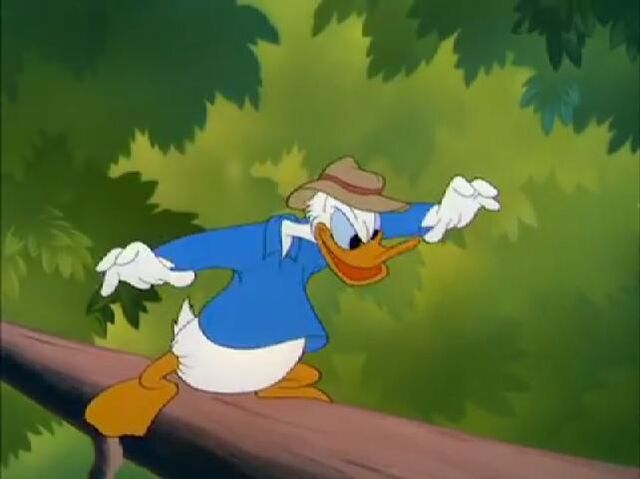
Something else I noticed when I watched this cartoon again is that it contains a very rare sight: it is one of the few times Donald Duck wears pants. When he's on the beach he wears swim trunks sometimes, but this is the only time I can remember seeing him wear full-length trousers. Even in "Old MacDonald Duck" he doesn't wear pants. Thus, his overalls in this short, if not a first, make for a very rare sight and an interesting image. He almost looks out of character in pants!

I love when little moments of animation can pop in some way. In this one, I am always amused by Donald's tip-toe walk behind Dale. How does a duck tip-toe? The animation cleverly figures it out by having him walk with his feet sort of sideways. And there's character to it as well. I find the "sneaky walk" charmingly amusing, and the moment where they walk up the tree is just perfect cartoon logic. This short has several great creative uses of cartoon logic which I will explore a little later.

Something I appreciate a lot about this particular cartoon is the color design, with the use of primary colors. The apples are focal points to the story, so they are painted with a red that pops. Donald contrasts in blue (the overalls make him more blue than usual), and the greens and yellows in the trees are nice. Donald's plane is a slightly orange red color, which also pops against the blue sky. I almost wonder if we could consider the use of red as indicative of Donald's property (meaning both the plane and the apples), but this is probably reading too much into it. Regardless, when I watch this one in comparison to other Donald, Chip and Dale cartoons of the period, the colors pop in a way that seems a bit unique to this short. The simplicity I think helps the short rest on the strength of its gags, as it really is a gag-driven cartoon, with a story that at times relies on the ridiculous more than some other cartoons of this period. So the art style presents it a bit more matter-of-factly, and I think that helps sell it.

In a similar vane, I find the tree design very interesting. The treetops are pretty stylized when compared to everything else, being basically just painted circles with some leaf squiggles defining their shape. Their uniformity helps sell Donald as the conscientious farmer (these are his crop and not wild trees). It's worth noting that Disney cartoons rarely get this stylized in this period. They don't start getting fully stylized and "outside the lines" until the early 1960s, when the modern look was used for One Hundred and One Dalmatians. That makes this cartoon unique in that the background art is ever so slightly hinting that way with the treetops ten years before the company would embrace that style.

The perspective animation with the apples rolling out of the silo right at camera is very nicely done. I'll try to point out things like this when we get to older cartoons and this type of thing is new and experimental. But even in this one, it shows the animators at the top of their craft who've got it down to a science. Shots like that make the moment more dynamic and thus make the cartoon more engaging.

There are aspects of this short that feel inspired by Warner Bros. It has more "cartoony" elements and sight gags than some others. I love that the silo has a flip-top. But nothing seems more "out there" than the climax with the "atomic pills". First, check out the assortment of poisons Donald has at his disposal. Besides pesticides, lye and arsenic, he's got "essence of TNT", which is pretty funny. He also has "atomic juice" and "atomic dust" apart from the "atomic pills". Just where does he get this stuff? And what could he possibly use it for on an orchard? That doesn't matter; the cartoon is about escalation and somehow in "cartoon logic" it makes perfect sense. Then we get to the funniest business, when the "atomic pill" is swallowed by his chicken, who then lays a ticking egg bomb (as you do). This is such a wonderfully outlandish cartoon idea, and yet in cartoon terms it makes a kind of sense. It's a beautifully timed gag with a payoff that ends the short with a bang. I love the little moments of Donald's thought process as he muses the wonder and terror of a ticking egg.

On the matter of the "atomic" attack, it's well worth remembering the time in which this cartoon was made. We had just entered the atomic age. After the bombing of Japan, we were engaged in a Cold War with Russia and developing better atomic weaponry. America at the time was engaged in combat in Korea. Many viewed Truman's bombing of the Japanese as ending World War II. The finality or threat of the "nuclear option" was probably quite prominent in their minds. Today, I doubt we'd ever have casual cartoon plotting with atomic power like this (complete with a little mushroom cloud when he drops it into his plane!). Yet for the time, I can see how it makes total sense for frustrated Donald to "go nuclear" on his enemies (Truman would be so proud). In shorts of the 1940s, Donald's anger often led him to pointing shotguns at his enemies. Full-on bombing with atomic power is a natural progression to his extremity. We might also view the ending from the perspective that Donald's bombing does not end up harming his targets, but only threatens or destroys his own property (his silo, his chickens), and ultimately he his hoisted by his own petard. Thus, while the "nuclear option" is very much of the time, we might view the cartoon as subversively reminding us of the danger to ourselves that we risk with such a weapon. All of this of course is subtext or critical examination after the fact, as the main concern is to be funny, which this cartoon is. But this is the only time I can recall a Disney short using atomic power in such a way.

Finally, we must come to the other element of the ending that is very much of its time, and that's the Chinese stereotype voice. For the final gag, Donald literally blows himself to China (through a hole in the earth). And so we hear from the hole an outlandish "ah so" voice that also plays the "applecore" game with Donald. It's a fun way to bring the joke around one last time, and playing on the old joke of going straight through the earth and coming out in China is a good one. I don't think we need to consider this moment particularly racist, and it's certainly not malicious in intent, though the depiction can be uncomfortable to modern sensibilities. And yet, because we never see the other party, it's possible that contemporary young audiences won't even get that it's a racial joke. To be honest, when I was a child and I first saw this cartoon, I never ever thought it was a Chinese voice. I had no idea who it was or why it sounded funny, but I figured maybe it was because of the echo down at the bottom of the deep hole. For all I knew, Donald was talking to some Mole Man or something. At the time, I didn't have context for blatant vaudevillian Asian stereotyping. Looking back on it now I think, "oh of course! He came out in China!" Because it's an audio gag rather than a visual one, I think it works okay out of context. Even if kids don't understand exactly what happened there, the recognition of the running gag still makes it work.

Sure, it would be easy for some extremists to write this one off as an example of racist cartoons that promote nuclear weapons or some such, but that would be to entirely miss the point. While this isn't the strongest cartoon from an animation standpoint, isn't particularly groundbreaking, and is fairly simple, it is that simplicity which gives it charm. The extremity and silliness of the "atomic pill" gag is unique and enjoyable, as well as the running applecore joke. Somehow, this cartoon manages to distinguish itself apart from the many similar shorts of Donald vs chipmunks. If nothing else, it's led whole generations to fondly remember "applecore, Baltimore" and seek out the origin. And perhaps the fact that it lingers in the memory like that is the best that can be said for any cartoon.

Saturday, April 11, 2015

196. Two Chips and a Miss

SERIES: Chip 'n' Dale
RELEASED: 1952
DIRECTOR: Jack Hannah
STORY: Nick George, Bill Berg

Chip and Dale each sneak out for a night on the town with Clarice, unaware that she has invited both of them. They arrive at the Acorn Club where she is performing, only to find they are rivals for her affections. Eventually, this leads to each of them warring for her attention on a different instrument accompanying her performance, until the three of them settle into performing a song together.

"Two Chips and a Miss" is the most unique short in the Chip and Dale canon and, along with "The Lone Chipmunks", most responsible for inspiring Chip 'n Dale Rescue Rangers in the 1980s. This is the second cartoon of their starring solo series after sharing numerous shorts with Donald Duck and Pluto. The first solo effort, "Chicken in the Rough", is typical Chip and Dale fare, and nothing much to write home about. It's not bad, but in my estimation not worthy of this list. However, their sophomore effort is a very interesting experiment as it features nuances of setting and character that don't feature in any of their other appearances of this period.

This is the first and, I believe, only cartoon that puts them in an urban setting. They are no longer animals living in Donald's backyard tree. They are Jiminy Cricket-type sophisticates who sleep in matchbox beds and wear clothing. Was this an attempt at spreading Jiminy's features to other characters? (He would appear again regularly on The Mickey Mouse Club in a few years.) Or perhaps it's a continuation of the success of the mice in Cinderella which had premiered a couple years before. Whatever the reason, this is one of the only cartoons until the Rescue Rangers series to put the chipmunks in clothes. They would dress up a couple of times with Donald, notably in "Out of Scale," but they always begins these shorts as naked animals and the clothes are humorous "add-ons". In this short, clothing is part of their everyday life. I like the decor of their treetop apartment, with the leaf-blinds and such. The invention with which the artists populate the chipmunks' world with familar things made from smaller objects is really well done. The night club tables are fungi, the bass guitar is a pencil and box, etc.

The plot seems to riff on popular screwball comedy tropes of the '40s, with the boys rivals for the affections of the same girl, and a focus on swinging night life. I admit I always giggle a little at Chip's internal monologue commenting on his reflection: "You gay dog, you!" Doubtful today this statement would signal him a ladies' man.

"Two Chips and a Miss" is the first short in which we are meant to fully understand the chipmunks' speech. Usually, it's a lot of sped-up, seemingly unintelligible chattering. Sometimes you can understand pieces of it, but apart from catchphrases like "Well, whaddya know!" the words they say are secondary to the physical comedy. The Disney studio tries a different approach in this short, for while it has physical comedy moments, it also requires the boys and Clarice have speaking roles. We are meant to see them as fully anthropomorphic characters here, and not rodent pests as in other shorts. They would revert to something a bit between their old voices and this short for many of their later appearances, though they would have intelligible dialogue in some appearances on Disney's TV program in the late 1950s.

A primary reason for having more understandable voice pitch here is the focus on Clarice's song, "My Destiny." This is the first and only appearance of Clarice as a love interest for Chip and Dale. When you hear her sing her song in her little chipmunk voice, it is well worth remembering that this is a full six years before Ross Bagdasarian, Jr. created Alvin and the Chipmunks. Watching this short, I realized that Disney had invented singing chipmunks first! A part of me wonders if Bagdasarian made his high-pitched singing trio "Chipmunks" because of Chip n' Dale.

The cartoon feels familiar in utilizing gags that are recognizable from other works of the period. The brief mirroring gag owes a debt to the Marx Brothers, while the Acorn Club section carries heavy Tex Avery connotations. The boys fawning over the shapely singer Clarice feels like an answer to "Red Hot Riding Hood", particularly in the moment where they briefly take on wolf form. In Disney terms, the short also ends on a note very reminiscent of early Mickey Mouse, where a problem goes away through the power of music. This becomes a very musical cartoon, which in this period of Disney animation was kind of a throwback to the way they used to do it. Chip and Dale playing away reminds me of Mickey and Minnie in similar situations. I like the culmination in warring instruments and differing musical styles. The moment when Clarice picks up tempo to match Chip's playing is nice. This scene almost seems to prefigure the Donald/Daffy piano war in Who Framed Roger Rabbit.

The little bits of slapstick rivalry between Chip and Dale are fun as far as they go, though they don't go very far. The characters are a bit more subdued from how we've seen them in other shorts; we've gone from The Three Stooges to Martin and Lewis. We've never seen the two fight against each other for a girl before. Indeed, they generally have the same goal in their cartoons. This time, by making them rivals for Clarice's affections, the Disney artists are expanding the kinds of stories these characters can tell. While we don't see this sort of thing again in the 1950s, it definitely seems to have planted seeds for the rivalry over Gadget Hackwrench on the TV series. Clarice is a real two-timer! She invites both of them secretly on the same night! What is she expecting? Did she just want butts in the seats (the club seems empty)? I get the feeling she likes Chip more; his note had more "kisses", and she seemed to respond more to his playing. She just likes being wanted. She's kind of a hussy, with her wink to the audience at the end, showing she's just playing them. Remember when two boys could accidentally kiss like that at the end of a cartoon and it was funny for what it was with no other connotations? Or when popular songs could refer to one's lover as "Little Girl" and it wasn't creepy? I miss the innocence of those days.

Chip 'n' Dale would follow this short with "The Lone Chipmunks", in which the two unwittingly help to catch a bank robber in the Old West. For this, they are made honorary deputies. I consider this the inspiration for their crime-fighting Rescue Rangers. Taken together, both of these shorts lay the groundwork for that popular television series and represent an attempt at stretching the characters beyond being simple antagonists. While "Two Chips and a Miss" never fully exploits or resolves the love triangle story, and remains a rather slight and moderately amusing cartoon on its own, its novelty in the Chip 'n' Dale oeuvre makes it a bit more than the sum of its parts. Its weaknesses keep it low on this list, but the defining unique characteristics make it something of a favorite of mine, if only because it's charmingly different.

Saturday, March 21, 2015

197. Out on a Limb


SERIES: Donald Duck
RELEASED: 1950
DIRECTOR: Jack Hannah
STORY: Bill Berg, Nick George

Once again we have Donald teamed up with Chip and Dale. There will be a lot of Chip and Dale shorts in the bottom 100, since many are worth watching, but few are true time-tested stand-outs. Donald Duck spent most of the late 1940s and 1950s paired with bees, Bootle Beetles, or Chip and Dale. Many of these are directed by Jack Hannah.

The story this time is typical Chip and Dale fare. Donald has come to do a little surgery on his tree, which just happens to be where Chip and Dale are residing. Donald decides to be mischievous and taunt the chipmunks for awhile with various trimming tools until the chipmunks fight back.

What I like about this one is that the story isn't born of a misunderstanding. This time around, Donald's just being a bit of a jerk because he gets off on pranking other people. This was always an element of the character, going back to some of his earlier shorts. It's been said a key to his character is that he can dish it out, but he can't take it. This short is a prime example of that philosophy and it's nice to see it's still alive in the '50s. Even in the later cartoons, when they really get Donald's character, it just works. Donald is not bad-natured or mean outright, but he does enjoy a bit of schadenfreude from time to time. It's worth pointing out that while he enjoys teasing the chipmunks, he doesn't want to hurt them, and indeed he even helps Dale from falling at one point. And it's all right because the tables usually turn on him by the end. Here, Chip and Dale aren't being pests, like in "Three For Breakfast" where they steal his food; he just wants to mess with them. You can also see the difference in character; when Donald causes Dale pain, he walks away and says, "That's funny," but when Dale causes Chip pain, his first words are, "Gosh, I'm sorry." Chip has elements of Donald's temper in this one, but maintains his friendship with Dale. In a way, the two chipmunks are split elements of Donald's psyche, especially in this one; Dale is the good-natured fun part that causes slapstick fun, Chip is the thinking one who is easily frustrated. But both exist harmoniously, while Donald is often at the whims of his temper. This short is also another step in helping to define who Chip and Dale are as individuals.

One element I don't always get to discuss in these posts is the background art. I wanted to highlight it here, because I really love the simple but artful way the backgrounds are handled in this cartoon. to suggest being up in a tree, the backgrounds are varying shades of green, with leaf patterns layered. The colors are soft and blend into each other like airbrush or watercolor. It's effective, and really quite lovely in its own way, perfectly capturing the setting but never pulling focus from the characters.


Later, when the story shifts to the "hunt" to kill the "monster", the backgrounds become bluer and a little foreboding to match the mood. The limbs become denser and more shadowed. It's very effective.

There's a bit of clever design with Donald's shears, as they ever so slightly evoke the head of a bird.
This is then carried on with Donald's "behavior" of it. Consider that the animators have to animate the notion of Donald animating an object, and all with very minor things that give the illusion of life. This is the craft of animation at its finest: to make something appear alive. We don't even question it in the context of the cartoon, but consider how just a few curved blades and a well-placed screw add up to a perfect design element for this gag. It's all about convincing Chip and Dale that it really is something alive, and it works. I've come to really love moments in Disney cartoons where inanimate objects are allowed to have the appearance of their own agency.

As you'd expect, the short eventually becomes a chase. While it doesn't last very long, the little chase in the treetop is energetic and fun in the way the layout has limbs that twist here and there. Donald finally taking a lawn mower to the leaves in frustration is a clever idea with very cartoony execution, as his speed is such that he can travel over empty space between branches as if none exists. He even gives the chipmunks a close-call haircut. Something about it seemed odd-looking to me until I realized why: Donald has shaved their ears off! But they don't seem to be hurt by it, and it is a visual gag that I'm sure probably wouldn't work well otherwise, the way their ears are placed. I don't think we're meant to truly consider their mutilation.

My main criticism of "Out on a Limb" is the geography and continuity of the limbs themselves. The very first thing Donald does is chop the limb in front of Chip and Dale's door. So after that whenever they go in and out, they have to somehow hop on other branches to get in, and this means branches will suddenly appear or disappear as they are needed. This bit of discontinuity is unfortunate in an otherwise nicely-conceived cartoon.


On an unrelated note, I want to give a thank you to anyone who is reading this and/or is interested in the list. I'm sorry that it's been a long time since I updated. I plan in the future to post a list of upcoming shorts so you can get a better sense of the countdown. We're only in the early stages; the best ones are yet to come!

Saturday, January 31, 2015

198. The Chain Gang


SERIES: Mickey Mouse
RELEASED: 1930
FIRST APPEARANCE OF: Pluto (sort of)

Mickey and the gang are in jail working on a chain gang (for no known reason) with Pete as their guard. Mickey uses music to lift everyone's spirits, but somehow this turns into a prison riot and an escape attempt. Mickey makes it out, but is chased by bloodhounds until landing safely back in prison.

I'm going to be honest here: I'm not a big fan of this one. I think most of the best things about it are done just as well if not better in other shorts. However, this short is of historical significance as it's the impetus for the creation of an important character: Pluto.

Most Disney reference material will cite this as the first appearance of Pluto. He is generally considered to be one of the two dogs that chase Mickey. But I don't consider either of these dogs to actually be Pluto. Their design doesn't match Pluto at all, even in his earliest form, nor are they named. But it is clear that their appearance inspired the creation of Pluto as we would come to know him. Pluto would make his first official appearance as himself two shorts from this in "The Picnic", and then he was Minnie's dog. But immediately after that, he became Mickey's and quickly developed into the canine companion that we've come to love. Whether or not Pluto technically appears in "The Chain Gang", the influence of those dogs to the creation of Pluto makes this short of great importance. Pluto allowed for greater stories to be told with Mickey, and a further development of his character.

The rest of this short is still mildly amusing. If you pay attention, it actually has more in common with the growing formula for the new Silly Symphony series than Mickey Mouse. Most Silly Symphonies of this era spend time using characters to riff on well-known musical themes (as the animals do here), and ultimately end in a chase scene. It seems as if the Disney studios were testing out what elements worked best for Mickey and what ones worked best for their new series.

Not that it's out of character for Mickey at all. Indeed, much of Mickey's appeal for the five years or so is how he uses music to spread goodwill in bad situations. After all, that's one of the primary themes of "Steamboat Willie". It's used to great effect here. We never know why Mickey is in jail, but while he's there, he can bring joy. Notice that everyone in the gang is morose until we get to the end of the line and Mickey is singing and smiling. Even when Pete tells him to shut up, his frown is short-lived. You'll notice also that Mickey responds, "Yes, Ma'am" to Pete. At the time, this was becoming something of a catchphrase for Mickey. I don't know why, but I always find it funny.

I like that all the different characters get different moments of dancing or musicality during the cartoon. They have individual personalities. The highlight for me is that tough-guy dog (who I don't think appears in other shorts) and the way that he dances. He has this great little moment of just sort of dancing muscly, and then this shifts to a dainty sort of dance with his ball and chain, accompanied by frivolous music and tweeting birds. It's a cute juxtaposition, and one of the few times I genuinely laugh during this cartoon.

It's interesting to see what different eras found acceptable. There is a lot of gunplay and bullet humor in this cartoon during the jailbreak sequence. Considering Disney actually edited a segment out of one of their movies for home video because it involved gunplay, it's amazing to see what they did back then. They would probably not make cartoons where characters comically get shot in the butt today, at least not in the same way. But at the time, it was just another in a series of sight gags.

There are some clever gags involving Mickey's ball and chain. I like how he uses it to escape. His chain actually breaks, and then Mickey goes back for the ball and carries it with him! That's cute. I enjoy little moments like that.

"The Chain Gang" has some historical significance and so I felt wrong about not including it. And there are moments that I find fun. But I do also feel like there's something lacking in it. I don't find it as funny as other Mickey shorts of the period. The musical moments aren't as solid, and the story is weak. The prison break comes out of nowhere just to have a climax. These are things I forgive in the early Silly Symphonies, but somehow this cartoon feels like it's not quite serving Mickey as well as it could. It's certainly a fine way to use the character, but I don't know that the situation is fully justified. Mickey is an everyman; is this short designed to speak to Americans on chain gangs? I guess I prefer my Mickey a little more domestic or a little more fanciful. This scenario never completely worked for me. It's an interesting development to have prison guards who are all clones of Pete (the real Pete is the one with the peg leg); they would use this tactic in other shorts; for example, as an entire football team. "The Chain Gang" is a notable cartoon, though certainly not among my true favorites. As a matter of taste, I prefer "The Shindig", but this one has a bit more plot even if it feels plotless at times. It's a curious stepping-stone for Mickey and for where the company was going at the time.


Friday, January 9, 2015

199. The Shindig


SERIES: Mickey Mouse
RELEASED: 1930

Mickey Mouse, Minnie, and the rest of the gang head out to the local barn dance for an evening of fun. Mickey and Minnie provide the music and everyone cuts a rug.

Many of the early Mickey Mouse cartoons fall into one of three categories.
1) Mickey solves some problem or makes light of a bad situation through music and dance
2) There is a performance of some kind, featuring Mickey
3) There's a dance or a party
"The Shindig" falls into this third category. The basic framework of everyone at the local barn dance goes all the way back to "The Barn Dance", the first new Mickey short after "Steamboat Willie". Among these types of shorts, "The Shindig" is one of my favorites. Each has its own little flavor, but I find this one to be particularly fun. It's definitely light on story (even the gags contained within aren't much), but it is an amusing distraction, and I think has a kind of joy that surpasses some other similar shorts.

Note the earliest version of the "Mickey in the sunburst" opening. That was introduced in 1930 with the short "Just Mickey". This is the earliest appearance of it in this countdown.

Horace Horsecollar and Clarabelle Cow appear here, having debuted several shorts earlier. I love the gag that the bell pull at Clarabelle's house is her tail. Notice that when Clarabelle is introduced, she is in bed reading a book called Three Weeks, which she hides under her mattress. The book was a work of erotic fiction that was first published several decades earlier and was likely back in the public eye due to a movie adaptation in 1924. Basically, it was the Fifty Shades of Grey of it's day, and audiences would likely have gotten a laugh out of it. I also think it's great to see more adult jokes like that in early shorts to remind people that Disney made these for a wide audience, and not just as "kid stuff".

When we get to the dance, the first song played is "Turkey in the Straw". This seems appropriate, as it was the centerpiece of Mickey's first sound cartoon, "Steamboat Willie". This is followed with one of my favorite bits in this cartoon, "Pop Goes the Weasel". Mickey's signature playfulness in instrumentation is on display here, as he pops paper bags, bangs buckets, and plays Minnie's tail. Mickey has a little bit of a naughty schoolboy in him as he snaps Minnie's underwear on the chorus! I love that he tries it again and she slaps him, singing, "Don't you do that!" That bit of business allows for a touch of character interaction beyond just the singing and dancing, and it's also pretty funny. Other shorts have some similar exchanges, but that's my favorite one. Learn your lesson kids: if you go around snapping girls' underwear, expect to get slapped.

It's important to remember that we are still early in the success of Mickey and Walt Disney. The bread and butter of these cartoons was the sound integration, which is why so many of them focus on musicality. As they went on, we got more dialogue as well. This cartoon is all about music and dance.  It is fun to trace the development of dance animation through Disney cartoons. The dances often depict not only changes in animation style, but changes in popular dance of the time. Clarabelle does a little slide dance that you see in other Disney cartoons of the period. I'll try to comment on interesting milestones in the Disney evolution of dance throughout this countdown.

You'll notice that besides mice, horses and cows, most of the extras in these shorts tend to be dogs and pigs. The "rubber hose" animation style is wonderfully exploited as Mickey dances with a dachsund lady whose serpentine body snakes about as they move. I'm always amused by the way pigs are designed in these early cartoons; usually the fatter the better. Pig design is another way to track Disney's animation style into the more sophisticated "realism" of the 1930s. "Three Little Pigs" is a far cry from these rotund dancing things, and it premiered just three years later. Mickey's dance with the pig lady is amusing. They loved doing fat jokes back then, but the rotund characters always seem jovial and not offended in any way. There's perhaps something subtextual about Mickey's character being so good-natured. He dances with characters of all shapes and sizes, from his own mouse girlfrend, to a cow, to a long skinny dog, to a big fat pig. And each time, all parties seem to enjoy themselves (save Minnie when he presses his advantage). The cartoon, in its simplicity, offers a world of enjoyment for everyone regardless of shape or size. All characters join in the fun. Mickey Mouse, even in his rougher state, was an ambassador of the transforming, healing, and uniting power of song and dance.